If you’re looking affordable private services in Saudi Arabia, contact Now for Umrah Taxi service.
Shuhada Uhud Cemetery Guide: History, Location, and Visiting the Martyrs of Uhud in Madinah


February 9, 2026
If you’re looking affordable private services in Saudi Arabia, contact Now for Umrah Taxi service.
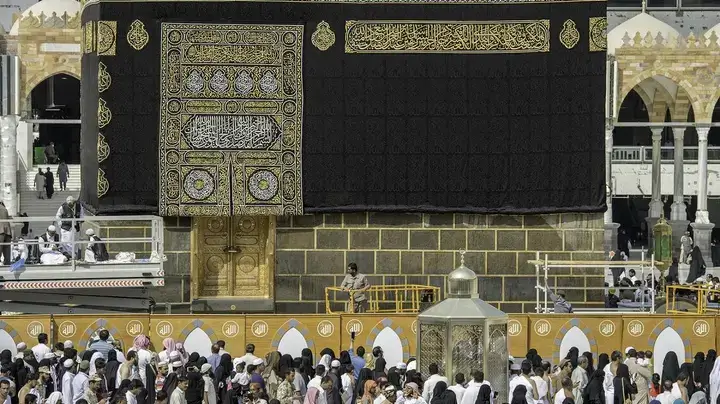
Al Kaaba, also known as Baytullah (the House of Allah), stands at the very center of Masjid al-Haram in Makkah, Saudi Arabia. More than a physical structure, the Kaaba represents the spiritual axis of Islam. Every day, over a billion Muslims across the world turn toward the Kaaba when offering their prayers, creating a unique global unity centered on this sacred building.
The Kaaba is not worshipped itself; rather, it symbolizes devotion to the One God. Its presence defines Makkah as the holiest city in Islam and makes Masjid al-Haram the most sacred mosque on Earth.
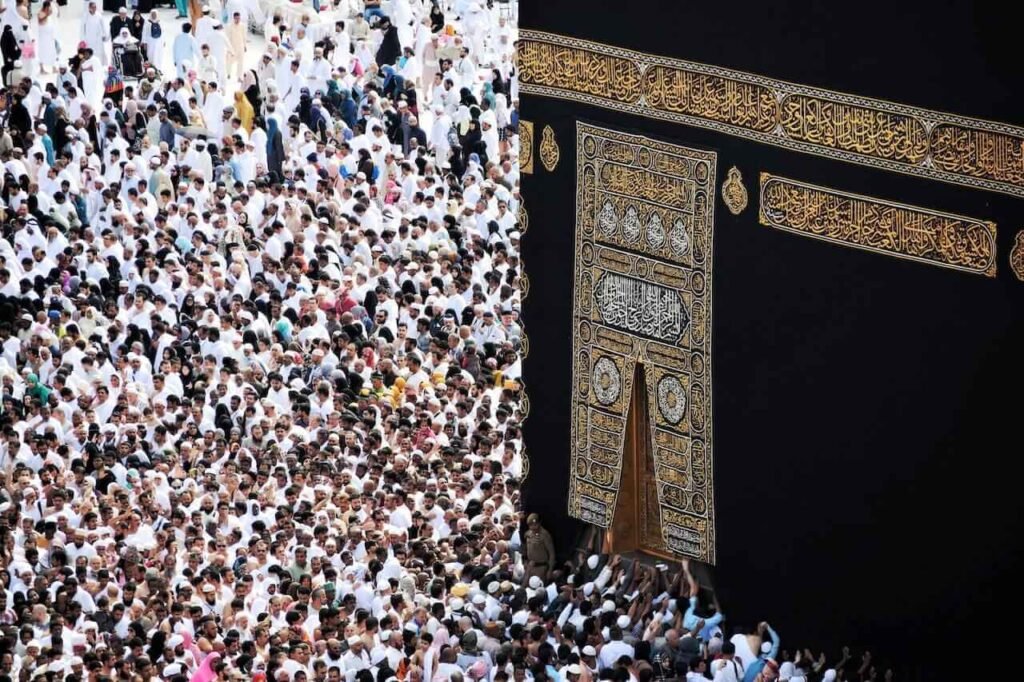
The Kaaba serves three foundational roles in Islamic belief. First, it is the Qibla, the direction Muslims face during prayer. Second, it is the focal point of Tawaf, the central ritual of both Hajj and Umrah. Third, it represents the first house established purely for the worship of Allah, as described in the Qur’an.
This combination of spiritual direction, ritual movement, and historical continuity gives the Kaaba its unmatched religious importance.
The Kaaba is located in the open courtyard of Masjid al-Haram, surrounded by the Mataf, the white marble area where pilgrims perform Tawaf. The mosque itself expands around the Kaaba in multiple levels, allowing millions of pilgrims to move in organized flow during peak seasons.
For visitors arriving in Makkah-whether from Jeddah airport, Madinah, or nearby cities-reaching Masjid al-Haram efficiently is a priority. Many pilgrims choose private Umrah taxi services from Jeddah to Makkah or group transport options to ensure timely and stress-free access, especially when traveling with family or elderly companions.
Islamic tradition states that the Kaaba was built by Prophet Ibrahim (Abraham) and his son Ismail, following divine command. They raised its foundations as a place dedicated solely to monotheistic worship, establishing it as a sanctuary of peace and devotion.
Before Islam, the Kaaba underwent several reconstructions due to floods and natural wear. Around 605 CE, the Quraysh rebuilt the structure. During this rebuilding, Prophet Muhammad, before prophethood, played a key role in resolving a tribal dispute by placing the Black Stone with wisdom and fairness.
Over centuries, the Kaaba was restored multiple times, notably during the Umayyad, Ottoman, and modern Saudi eras. Despite these renovations, its essential form, location, and spiritual function have remained unchanged.
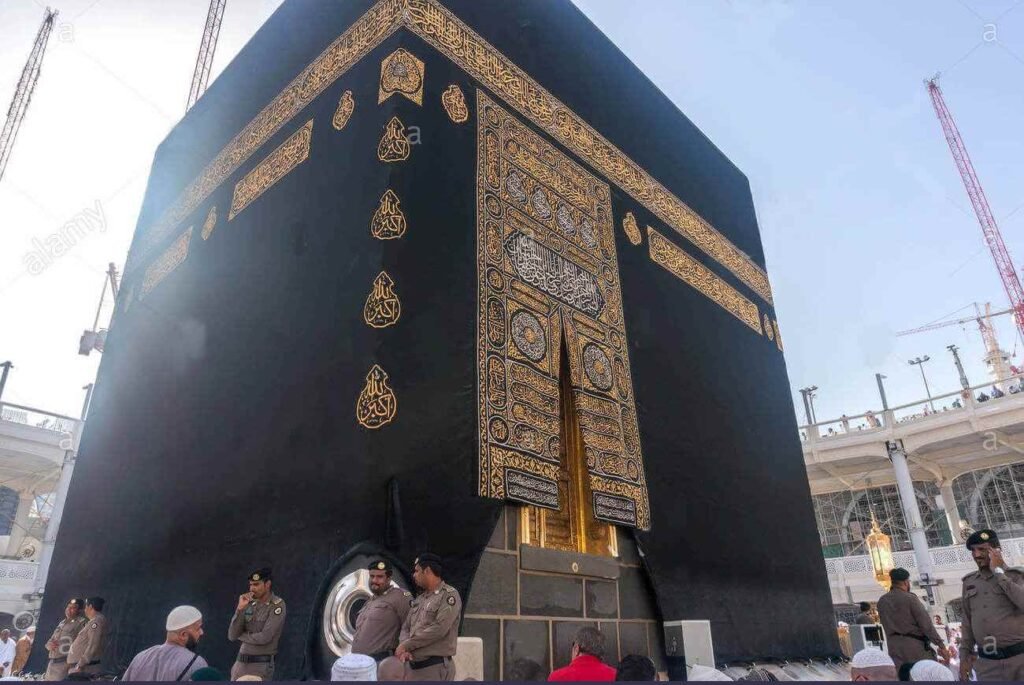
The Kaaba is a stone cuboid structure, approximately 15 meters high, with sides measuring roughly 12 meters by 10.5 meters. It is constructed from local Meccan stone, reinforced with marble and granite, ensuring durability under immense foot traffic.
Each corner faces a general cardinal direction:
The Kaaba features the golden door, elevated above ground level, the Mizab al-Rahmah (gold rainwater spout), and the Shadharwan, a protective marble base around its foundation.
Inside, the Kaaba is simple and serene. Three wooden pillars support the roof, with marble floors, hanging lamps, and silk-covered upper walls. Entry is limited to authorized individuals, preserving its sanctity.
Set into the eastern corner, the Black Stone marks the starting point of Tawaf. While pilgrims strive to touch or gesture toward it, the act is symbolic of devotion, not obligation. The stone itself has been preserved and repaired throughout history and remains one of the most recognized sacred objects in Islam.
The Kaaba is draped in the Kiswah, a black silk cloth embroidered with gold Qur’anic verses. It is replaced annually, reflecting care, honor, and continuity of tradition. The replacement typically occurs during the Hajj season and is performed with ceremonial precision.
Adjacent to the Kaaba is Hijr Ismail, a semi-circular area originally part of the Kaaba’s foundation. Prayer within this space is considered equivalent to praying inside the Kaaba itself. Nearby stands Maqam Ibrahim, containing the stone associated with Prophet Ibrahim during construction.
Tawaf involves circling the Kaaba seven times counter-clockwise, beginning at the Black Stone. It symbolizes the unity of believers in worship and submission to Allah. Tawaf is an essential pillar of both Umrah and Hajj, performed within the Mataf area.
Pilgrims often combine Tawaf with Makkah Ziyarat, visiting sacred historical locations. Reliable private Ziyarat taxi services help pilgrims manage these visits comfortably, especially during busy seasons.
The Kaaba is regularly cleaned using Zamzam water mixed with rose essence, oud, and musk. This process is carried out by designated custodians and reflects deep respect for the sacred space. Structural inspections and restorations ensure long-term preservation.
For pilgrims traveling between Jeddah, Makkah, and Madinah, planning transportation is essential. Many choose licensed private taxis, Hyundai Staria, Toyota Hiace, or Coaster buses for group travel to maintain flexibility, comfort, and punctuality. Efficient transport allows pilgrims to focus on worship rather than logistics.
Al Kaaba stands as the spiritual center of Islam, uniting believers across continents through prayer, pilgrimage, and shared devotion. Its history, structure, and rituals reflect centuries of faith and continuity. Visiting the Kaaba is not merely a journey to Makkah-it is a deeply transformative experience rooted in belief, humility, and connection with Allah.
What is the Kaaba made of?
The Kaaba is built from local Meccan stone, reinforced with marble and granite, and covered with the Kiswah.
Why do Muslims face the Kaaba during prayer?
The Kaaba is the Qibla, established by divine command as the unified direction for prayer.
Can anyone enter the Kaaba?
Entry is restricted to authorized individuals on special occasions.
Is touching the Black Stone mandatory?
No. Touching or gesturing toward it is recommended but not obligatory.
What is the best way to reach Masjid al-Haram?
Pilgrims often use private Umrah taxis from Jeddah or group transportation from Madinah for convenience and time management.