What Is Inside the Kaaba? A Complete Guide to the Sacred Interior of the House of Allah
What Is Inside the Kaaba?
The inside of the Kaaba is one of the most sacred and least-seen spaces in the Islamic world. While millions of pilgrims circumambulate the Kaaba every year, very few people are ever permitted to step inside it. Contrary to common assumptions, the interior is not filled with objects or ornamentation meant to impress the eye. Instead, it reflects profound simplicity, purity, and spiritual focus, perfectly aligned with the concept of tawhid, the absolute oneness of Allah.
The Kaaba’s interior is a single, enclosed prayer space designed not for display, but for devotion. Every element inside serves either a structural, historical, or spiritual purpose, reinforcing the Kaaba’s role as the symbolic heart of Islamic worship.
The Interior Layout and Physical Structure of the Kaaba
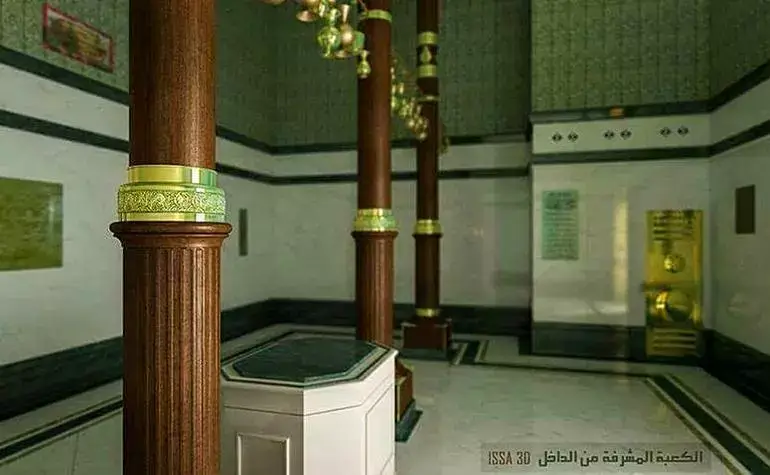
From the inside, the Kaaba feels more intimate than its towering exterior suggests. This is due to the thick stone walls, which reduce the internal area to approximately 180 square meters. The floor is elevated slightly above the surrounding Mataf area and covered with polished white marble, bordered by darker marble strips that subtly define the space.
The lower portion of the interior walls is clad in rose-colored and white marble, rising several meters high. Above this marble lining, the walls and ceiling are draped in a green silk cloth, richly embroidered with Qur’anic verses in silver and gold thread. This cloth extends seamlessly across the ceiling, creating a tranquil and unified visual atmosphere.
Key Elements Found Inside the Kaaba
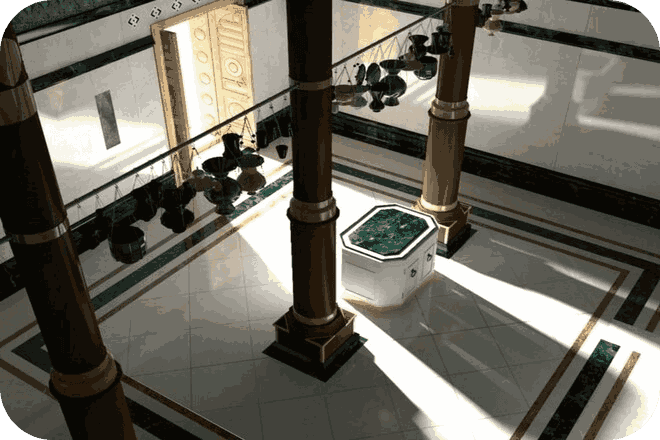
At the heart of the Kaaba stand three wooden pillars, aligned in a row down the center of the space. Made from ancient teakwood, these pillars are over 1,300 years old and date back to the reconstruction carried out by Abdullah ibn al-Zubayr. Each pillar supports the roof and stands as a silent witness to centuries of worship and history.
Suspended between the pillars are lanterns and incense burners, many of which originate from the Ottoman era. Crafted from gold, silver, copper, and glass, these lamps were gifted by caliphs, sultans, and kings throughout Islamic history. During ceremonial occasions, they are used to perfume the interior with oud, musk, and Ta’if rose oil, a fragrance known to linger long after the doors are closed.
Embedded in the marble walls are historical plaques and inscriptions, documenting restorations and expansions carried out by various Muslim rulers. These inscriptions serve as a physical record of the continuous care given to the House of Allah across generations.
Near the entrance, dark marble markings on the floor indicate the spot where the Prophet Muhammad ﷺ prayed when he entered the Kaaba. Another marked area near the wall commemorates where he pressed his chest and cheek in supplication, making heartfelt du‘a.
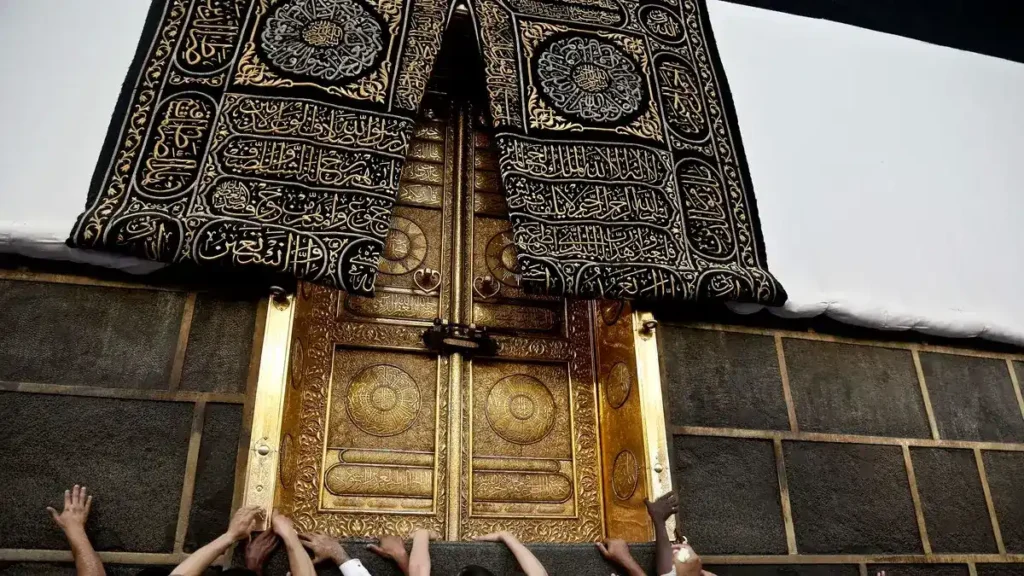
On the right side after entering is Bab al-Tawbah, the Door of Repentance. This small internal door leads to a staircase ascending to the roof of the Kaaba, primarily used for maintenance and for changing the Kiswah.
A dedicated cabinet inside stores sacred items such as oud oil, rose oil, and incense burners, all used during the ritual washing and perfuming of the Kaaba.
Spiritual Meaning of the Kaaba Interior
One of the most profound aspects of the Kaaba inside is that there is no qibla. When a person prays inside, they may face any direction because they are already within the focal point of prayer itself. This reality powerfully symbolizes that closeness to Allah is not about direction, decoration, or form, but about presence, humility, and sincerity.
The interior’s emptiness is intentional. There are no idols, no graves, no hidden relics. The space exists solely to affirm the worship of Allah alone, free from distractions.
Who Is Allowed to Go Inside the Kaaba?
Access to the inside of the Kaaba is extremely restricted. Entry is typically granted only during the ceremonial washing of the Kaaba, which usually occurs once or twice a year. Those permitted include selected Saudi officials, custodians of the Kaaba, religious scholars, and invited dignitaries.
There is no public system, registration, or payment option to enter the Kaaba. Even many scholars and imams spend their entire lives without stepping inside. Those who do enter usually stay briefly, pray two rak‘ahs, make du‘a, and exit promptly.
Hijr Ismail – How Pilgrims Can Pray “Inside” the Kaaba
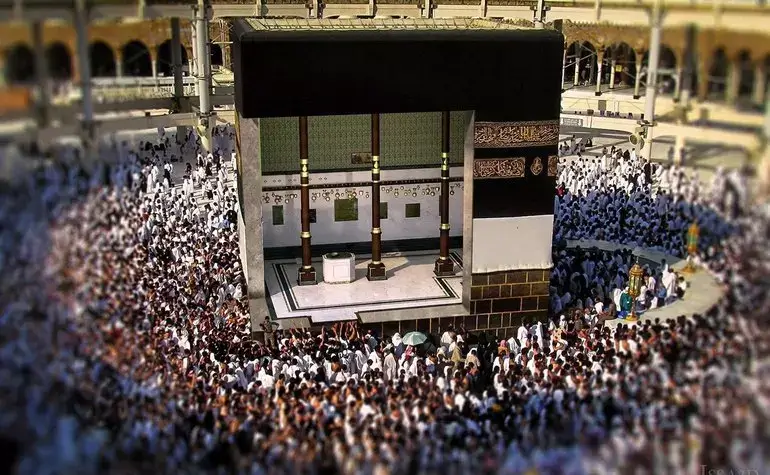
Islamic law provides mercy and accessibility through Hijr Ismail (also called al-Hatim), the semi-circular area adjacent to the Kaaba. This space is part of the Kaaba’s original foundations, and praying there is considered equivalent to praying inside the Kaaba.
Pilgrims performing Umrah or Hajj are encouraged to pray in the Hijr when possible, especially during quieter hours at night. Facing any direction within the Hijr is valid, and many scholars highlight it as the most practical way for ordinary pilgrims to attain the spiritual reward of praying inside the Kaaba.
A Brief Historical Journey of the Kaaba’s Interior
Before Islam, the Kaaba’s interior was filled with idols introduced by the Quraysh, despite being originally built by Prophet Ibrahim عليه السلام as a house for monotheistic worship. By the time of the Prophet Muhammad ﷺ, 360 idols surrounded and occupied the Kaaba.
During the Conquest of Makkah, the Prophet ﷺ ordered all idols and images inside the Kaaba to be destroyed. Only after its purification did he enter, pray inside, and restore the Kaaba to its original purpose as a sanctuary devoted solely to Allah.
Since then, every reconstruction and renovation has preserved the Kaaba’s simplicity, sanctity, and spiritual focus, ensuring that nothing distracts from worship.
Visiting Makkah for Umrah or Ziyarat
For pilgrims traveling to Makkah to experience the spiritual atmosphere surrounding the Kaaba, smooth and respectful transportation plays an important role. Many visitors choose private Umrah taxi services from Jeddah to Makkah, allowing them to arrive rested and focused for worship.
Ziyarat trips within Makkah and Madinah, as well as group transportation using Hiace, Coaster, or Bus, help pilgrims move comfortably between sacred sites such as Masjid al-Haram, Masjid an-Nabawi, and historical locations tied to the life of the Prophet ﷺ. Reliable private transport ensures pilgrims can focus on ibadah rather than logistics.
Conclusion
The inside of the Kaaba is not defined by grandeur, but by meaning. Its marble floors, ancient pillars, Qur’anic inscriptions, and quiet emptiness all point to one truth: the Kaaba exists to unite hearts in the worship of Allah alone. While only a few ever step inside, every believer can connect spiritually through tawaf, prayer in Hijr Ismail, and sincere du‘a near the House of Allah.
Understanding what lies within the Kaaba deepens reverence for it and reminds pilgrims that closeness to Allah is achieved not by access, but by intention.
FAQs
What is inside the Kaaba?
Inside the Kaaba is a simple prayer space with marble flooring, three wooden pillars, Qur’anic inscriptions, hanging lanterns, prayer markers, and a staircase leading to the roof.
Can ordinary pilgrims enter the Kaaba?
No, entry is highly restricted and limited to special occasions. Ordinary pilgrims cannot book or request entry.
Where can pilgrims pray that counts as being inside the Kaaba?
Praying in Hijr Ismail counts as praying inside the Kaaba because it is part of its original structure.
How often is the Kaaba cleaned?
The Kaaba is washed ceremonially once or twice a year using Zamzam water mixed with rose and oud oils.
Why is the Kaaba interior so empty?
The simplicity reflects Islamic monotheism, removing all distractions so worship is directed solely to Allah.