If you’re looking affordable private services in Saudi Arabia, contact Now for Umrah Taxi service.
Talbiyah Umrah Guide: Meaning, Arabic Text, When to Recite & Common Mistakes


February 15, 2026
If you’re looking affordable private services in Saudi Arabia, contact Now for Umrah Taxi service.
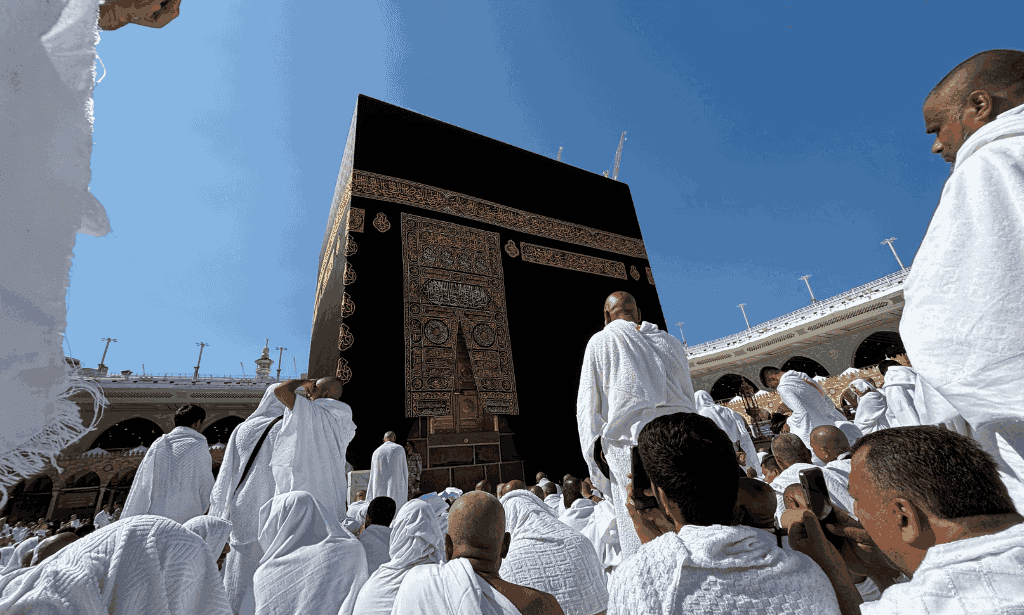
The Kaaba stands at the spiritual and physical center of Islam, located within Masjid al‑Haram in Makkah. For over millennia, this cube-shaped structure has been the focal point of prayer, pilgrimage, and unity for Muslims across the world. Five times a day, millions face the Kaaba in prayer, while every year, pilgrims gather around it to perform Tawaf during Hajj and Umrah.
Understanding the history of the Kaaba is not only about tracing architectural changes; it is about understanding the evolution of monotheistic worship, the trials of faith, and the preservation of a sanctuary ordained by divine command. From its origins associated with Prophet Ibrahim to its last major reconstruction in 1626, the Kaaba’s story mirrors the spiritual journey of humanity itself.
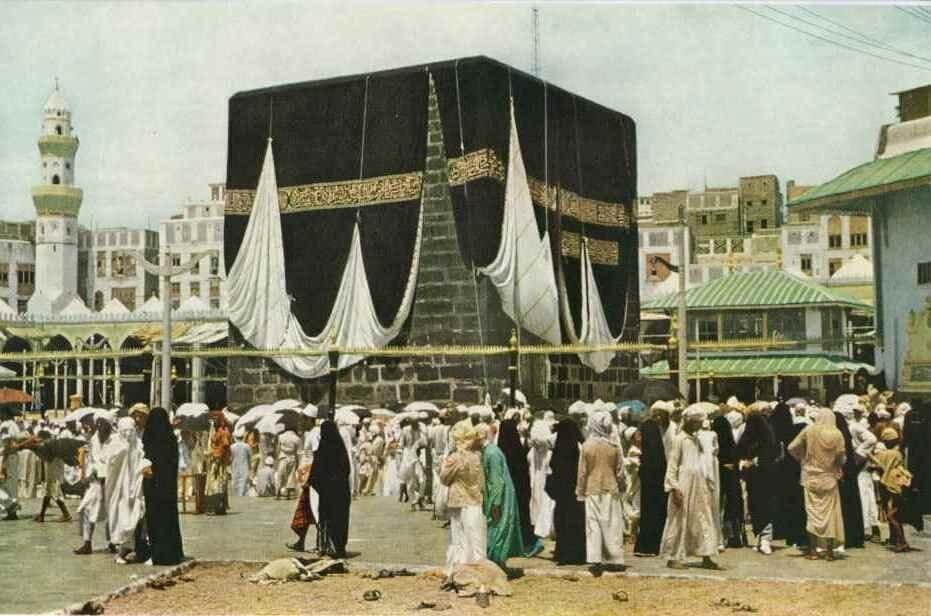
The Kaaba is regarded as Bayt Allah, the House of Allah, and is described in the Qur’an as the first house of worship established for mankind. Its importance transcends geography-it symbolizes unity, equality, and devotion, as all believers stand shoulder to shoulder facing a single direction regardless of nationality or status.
Beyond ritual prayer, the Kaaba defines the rites of Hajj and Umrah. Every pilgrim must circumambulate it, reenacting the devotion of generations before them. This unbroken continuity is what makes the Kaaba not only a physical structure but a living testament to Islamic history.
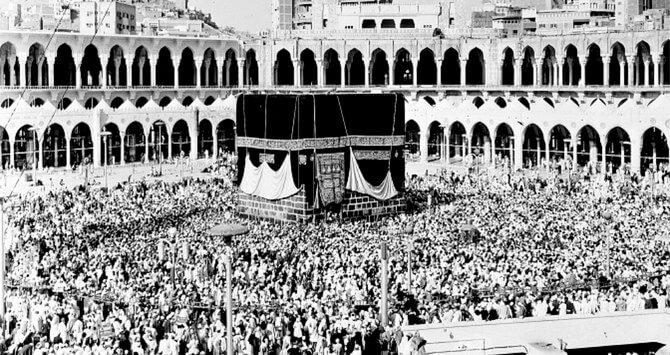
Islamic tradition teaches that the Kaaba’s origins predate recorded human history. Some narrations associate its earliest foundations with the time of Prophet Adam, marking the site as sacred from humanity’s earliest days. Though these early structures vanished over time, the sanctity of the location remained divinely preserved.
The most definitive foundation of the Kaaba is attributed to Prophet Ibrahim and his son Prophet Ismail. Acting upon Allah’s command, they raised the Kaaba’s walls as a house dedicated purely to monotheistic worship. The Qur’an records their supplication, emphasizing sincerity, submission, and divine acceptance.
This construction established Makkah as a sacred sanctuary, a place where bloodshed was forbidden and pilgrims were guaranteed safety-principles that shaped the city’s spiritual identity long before Islam’s formal revelation.
One of the most revered elements of the Kaaba is the Black Stone, embedded in its eastern corner. According to tradition, it was brought by the angel Jibreel and placed by Ibrahim during construction.
Though not worshipped, the Black Stone symbolizes the covenant between Allah and humanity. Pilgrims strive to touch or gesture toward it during Tawaf, following the practice of Prophet Muhammad. Its survival through fires, floods, and reconstructions makes it one of the few remaining physical links to the earliest history of the Kaaba.
Recommended: What Is Inside the Kaaba?
Before Islam, guardianship of the Kaaba belonged to the Quraysh tribe. Their custodianship granted Makkah prestige and transformed it into a thriving trade hub linking Yemen, the Levant, and beyond. Pilgrimage seasons doubled as commercial gatherings, reinforcing the Kaaba’s central role in Arabian life.
Over centuries, monotheism faded, and idols filled the Kaaba. Each tribe placed its deity inside or around the structure, while still respecting the Kaaba as a sacred sanctuary. Despite this deviation, core rituals such as pilgrimage and circumambulation persisted, preserving the site’s spiritual framework until Islam restored its original purpose.
Around 605-608 CE, severe flooding damaged the Kaaba, prompting the Quraysh to rebuild it using stone and wood. Financial constraints forced them to reduce its size, leaving part of Ibrahim’s original foundation outside the walls-now marked by the Hijr Ismail.
During this reconstruction, a dispute erupted over who would place the Black Stone. The young Prophet Muhammad resolved the conflict by having all clan leaders lift the stone together on a cloth, demonstrating wisdom and preventing bloodshed. This moment foreshadowed his future role as a unifier.
In the early Islamic period, Muslims initially prayed toward Jerusalem. In 624 CE, divine revelation redirected the qiblah toward the Kaaba, restoring it as the central axis of Islamic worship and reaffirming its Abrahamic foundation.
In 628 CE, Muslims were prevented from entering Makkah to perform Umrah. The resulting Treaty of Hudaybiyyah granted them the right to return peacefully the following year, marking a turning point in Islamic-Meccan relations.
In 630 CE, Prophet Muhammad entered Makkah peacefully, removed the idols from the Kaaba, and rededicated it solely to the worship of Allah. This event permanently transformed the Kaaba into the uncontested center of Islamic faith and pilgrimage.
During civil conflict, the Kaaba was damaged by fire and siege. Abdullah ibn al-Zubayr rebuilt it, incorporating the Hijr Ismail into the structure and restoring it closer to Ibrahim’s original design.
Following another siege, Umayyad ruler Abd al-Malik ordered the Kaaba rebuilt in the Quraysh-era cubic form, leaving the Hijr outside. This structure defined the Kaaba’s dimensions for centuries to come.
In 1626, catastrophic flooding caused the Kaaba’s walls to collapse. Under Ottoman authority, the structure was completely rebuilt using local granite reinforced with iron and wood. This renovation established the Kaaba’s current form, which has remained architecturally consistent ever since.
Today’s Kaaba stands approximately 13 meters high, draped in the Kiswah-an embroidered black cloth replaced annually. Key features include the raised door, the Black Stone, Hijr Ismail, and the nearby Maqam Ibrahim. Each element reflects layers of history preserved through careful stewardship.
For modern pilgrims, visiting the Kaaba is the culmination of a deeply spiritual journey. Travelers arriving via Jeddah to Makkah often rely on private Umrah taxi services to ensure comfort, punctuality, and focus on worship. Ziyarat journeys in Makkah and Madinah further contextualize the Kaaba within the broader prophetic landscape, especially for families and groups traveling together in Hiace, Coaster, or bus services.
Reliable transportation allows pilgrims to engage with history not as observers, but as participants continuing a tradition thousands of years old.
The history of the Kaaba is a narrative of faith restored, challenged, and preserved. From Ibrahim’s foundations to the Ottoman reconstruction of 1626, the Kaaba has endured natural disasters, political turmoil, and spiritual deviation-yet remains unchanged in purpose. It stands today as the ultimate symbol of unity, devotion, and continuity in Islam, drawing hearts and footsteps from every corner of the world.
Recommended Our Private Taxi Service
What is the Kaaba?
The Kaaba is the holiest site in Islam, located in Masjid al-Haram in Makkah, and serves as the direction of prayer for all Muslims.
Who built the Kaaba originally?
Islamic tradition attributes its reconstruction to Prophet Ibrahim and his son Ismail by Allah’s command.
Why is the Black Stone important?
It symbolizes a divine covenant and is part of the original Kaaba structure placed by Ibrahim.
When was the Kaaba last rebuilt?
The last major reconstruction occurred in 1626 after severe flooding, resulting in the structure seen today.
Can anyone enter the Kaaba?
Entry is restricted and granted only on rare occasions to selected individuals.