If you’re looking affordable private services in Saudi Arabia, contact Now for Umrah Taxi service.
Talbiyah Umrah Guide: Meaning, Arabic Text, When to Recite & Common Mistakes


February 8, 2026
If you’re looking affordable private services in Saudi Arabia, contact Now for Umrah Taxi service.
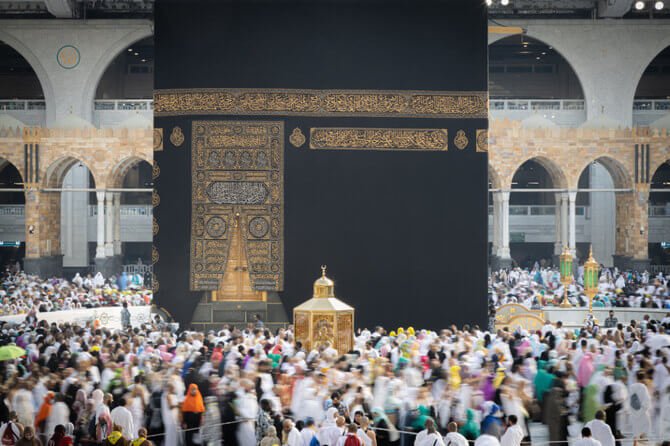
Maqam Ibrahim, meaning the Station of Prophet Ibrahim (Abraham), is one of the most sacred and spiritually significant landmarks inside Masjid al-Haram in Makkah. It is directly connected to the construction of the Kaaba and is deeply embedded in the rituals of Umrah and Hajj, making it a focal point for millions of pilgrims every year.
This guide explains Maqam Ibrahim with historical accuracy, Qur’anic context, practical guidance for prayer, and essential etiquette, helping pilgrims understand both its meaning and proper observance.
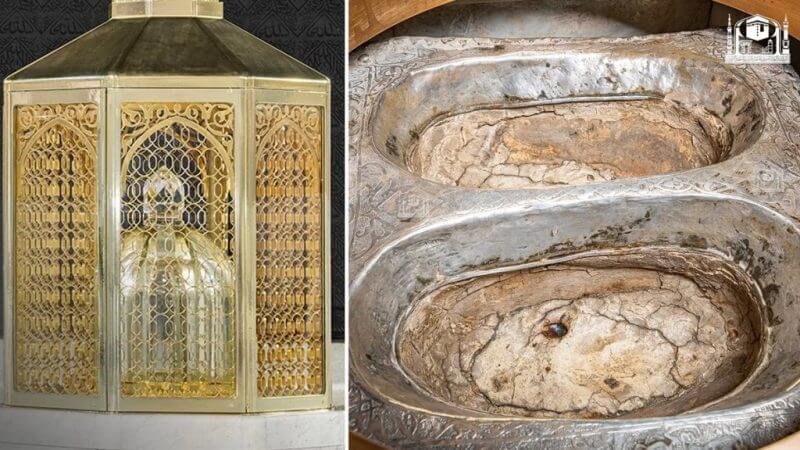
Maqam Ibrahim is a small stone bearing the footprints of Prophet Ibrahim عليه السلام, preserved as a clear sign for believers. According to Islamic tradition, Prophet Ibrahim stood on this stone while raising the upper walls of the Kaaba, with his son Ismail assisting him by handing over stones.
By Allah’s will, the stone softened beneath his feet, preserving their imprint. This physical sign remains visible today and serves as a reminder of obedience, submission, and devotion to Allah.
When the Kaaba’s walls grew higher during construction, Prophet Ibrahim used this stone as a standing platform. Classical narrations describe how the stone rose and lowered as needed, allowing him to complete the structure. After the construction was completed, Prophet Ibrahim prayed near this very spot.
Initially, Maqam Ibrahim stood close to the Kaaba itself. During the caliphate of Umar ibn al-Khattab رضي الله عنه, it was moved slightly eastward to ease Tawaf movement as the number of pilgrims increased. This decision preserved both the sanctity of the site and the safety of worshippers.
Maqam Ibrahim is explicitly mentioned in the Qur’an, emphasizing its religious authority and legitimacy.
Allah says:
“And take from the Maqam of Ibrahim a place of prayer.” (Surah Al-Baqarah 2:125)
It is also mentioned as one of the clear signs within the Sacred House:
“In it are clear signs, including the Station of Ibrahim.” (Surah Aal-Imran 3:97)
The Prophet Muhammad ﷺ acted upon this command by praying two rak’ahs behind Maqam Ibrahim after Tawaf, establishing it as a Sunnah practice for the Ummah.
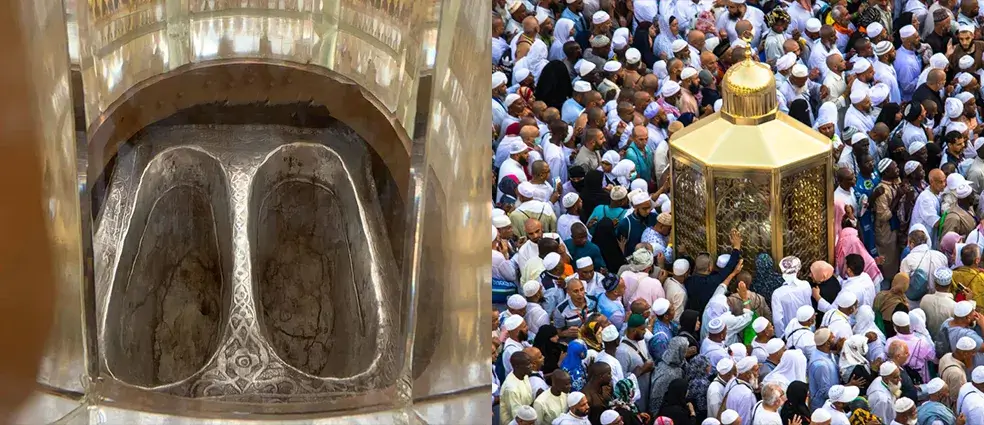
The stone of Maqam Ibrahim is nearly square, measuring approximately 40–50 cm in length and width and about 20 cm in height. Its color appears as a mix of whitish, yellow, and reddish tones. Two oval-shaped depressions mark the footprints, which have softened over centuries due to early pilgrims touching the stone before it was protected.
Today, Maqam Ibrahim is enclosed within a gold-plated metal frame and crystal glass casing, designed to preserve the stone while allowing pilgrims to view it clearly. This modern enclosure was introduced to ensure smooth Tawaf flow and protect the sanctity of the site.
Maqam Ibrahim is located approximately 10–11 meters east of the Kaaba, directly facing the Kaaba’s door, within the Mataf area where Tawaf is performed.
Although close to the Kaaba, pilgrims are not required to pray immediately next to the enclosure. Any location within Masjid al-Haram that places Maqam Ibrahim between the worshipper and the Kaaba fulfills the Sunnah requirement.
Maqam Ibrahim represents unwavering faith, obedience, and reliance upon Allah. It symbolizes the continuity of monotheism from Prophet Ibrahim to Prophet Muhammad ﷺ.
Many scholars mention that it is a place where du‘a is more likely to be accepted, especially after completing Tawaf and the two rak’ahs of prayer. The station reminds believers that great acts of worship are built upon humility and submission rather than physical closeness or outward actions.
After completing seven rounds of Tawaf, pilgrims should move slightly away from the Mataf flow and pray two short rak’ahs, positioning Maqam Ibrahim between themselves and the Kaaba if possible without causing harm or obstruction.
If the area is crowded, it is completely valid to pray anywhere inside Masjid al-Haram with the correct intention. Safety and consideration for others take precedence.
It is Sunnah to recite:
After completing the prayer, pilgrims may make a brief personal du‘a before proceeding toward Sa‘i.
Pilgrims should avoid stopping suddenly within Tawaf lanes, pushing toward the enclosure, or attempting to touch the glass casing. There is no religious virtue in touching or kissing Maqam Ibrahim, and such actions can endanger others.
Following security instructions and maintaining smooth movement ensures that worship remains sincere and safe for everyone.
Early morning hours and late-night periods are generally less crowded. However, pilgrims should prioritize ease and safety over proximity, as the reward lies in intention and adherence to Sunnah rather than physical closeness.
Most pilgrims visit Maqam Ibrahim as part of their Umrah or Hajj journey. Reliable transportation plays an important role in ensuring timely arrival at Masjid al-Haram, especially for elderly pilgrims and families.
Private Jeddah to Makkah taxi services, organized Makkah ziyarat taxis, and group transportation using Hiace, Coaster, or Bus help pilgrims focus on worship rather than logistics. Similarly, those continuing their journey can benefit from Madinah ziyarat taxi services to complete their spiritual itinerary with comfort and ease.
Maqam Ibrahim is not merely a historical artifact; it is a living symbol of faith, obedience, and continuity of worship. Understanding its significance, praying correctly, and observing proper etiquette allows pilgrims to fulfill this Sunnah with clarity and sincerity. When approached with humility and knowledge, Maqam Ibrahim becomes a deeply transformative part of the Umrah and Hajj experience.
Is it mandatory to pray directly behind Maqam Ibrahim?
No. You may pray anywhere in Masjid al-Haram as long as Maqam Ibrahim is between you and the Kaaba directionally.
Can Maqam Ibrahim be touched or kissed?
No. There is no religious basis for touching or kissing the enclosure.
Is Maqam Ibrahim part of Tawaf?
No, but praying two rak’ahs after Tawaf behind it is a Sunnah practice.
What makes Maqam Ibrahim special?
It contains the preserved footprints of Prophet Ibrahim and is explicitly mentioned in the Qur’an.
Can du‘a be made after praying there?
Yes, brief personal du‘a is recommended after the two rak’ahs.