
If you’re looking affordable private services in Saudi Arabia, contact Now for Umrah Taxi service.

Shuhada Uhud Cemetery Guide: History, Location, and Visiting the Martyrs of Uhud in Madinah


March 8, 2026
If you’re looking affordable private services in Saudi Arabia, contact Now for Umrah Taxi service.

Performing Umrah is a deeply spiritual journey that begins with entering the sacred state of Ihram. One of the most important acts that marks this moment is the recitation of Talbiyah, a powerful declaration of devotion and submission to Allah.
The Talbiyah is a special form of remembrance recited by pilgrims performing Umrah or Hajj. Through these words, a pilgrim responds to Allah’s call to visit the Sacred House and confirms their intention to complete the pilgrimage. For many Muslims, repeating Talbiyah throughout the journey from the miqat until arriving at Masjid al-Haram creates a constant connection with the purpose of their journey.
Understanding the meaning, timing, and correct way to recite Talbiyah helps pilgrims perform Umrah more confidently and spiritually.
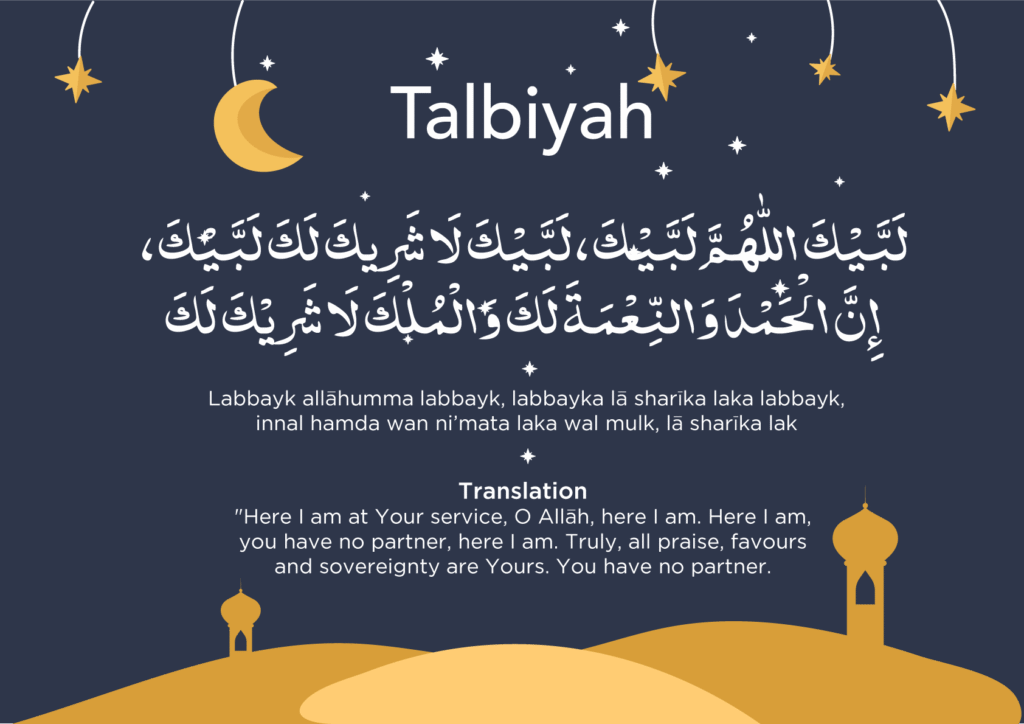
Talbiyah is a devotional phrase recited by pilgrims after making the intention (niyyah) to enter the state of Ihram for Umrah or Hajj. It is essentially a response to the divine call of pilgrimage.
By reciting Talbiyah, the pilgrim declares that they are present in obedience to Allah alone and that He has no partner. This recitation marks the official beginning of the pilgrimage rituals.
Islamic scholars consider Talbiyah highly significant in the rites of Umrah. In the Hanafi and Maliki schools of jurisprudence, it is considered obligatory for the validity of the pilgrimage, while other schools view it as a strongly emphasized Sunnah.
Regardless of the legal interpretation, reciting Talbiyah is a central part of the spiritual atmosphere of Umrah.
Once a pilgrim enters Ihram at the miqat, Talbiyah becomes a continuous form of remembrance during the journey toward the Kaaba.
The recitation symbolizes several key meanings:
Pilgrims repeat Talbiyah throughout their journey to maintain awareness that every step they take is an act of worship.
The Talbiyah is traditionally recited in Arabic.
Arabic Text
لَبَّيْكَ اللّٰهُمَّ لَبَّيْكَ
لَبَّيْكَ لَا شَرِيكَ لَكَ لَبَّيْكَ
إِنَّ الْحَمْدَ وَالنِّعْمَةَ لَكَ وَالْمُلْكَ
لَا شَرِيكَ لَكَ
Transliteration
Labbayka Allahumma labbayk
Labbayka la sharika laka labbayk
Innal hamda wan ni‘mata laka wal mulk
La sharika lak
Meaning
“Here I am at Your service, O Allah, here I am.
Here I am, You have no partner, here I am.
Surely all praise, blessings, and sovereignty belong to You.
You have no partner.”
These words summarize the essence of Islamic belief: complete devotion to Allah alone.
The Sunnah method of reciting Talbiyah includes brief pauses between phrases, which creates a calm and reflective rhythm.
Pilgrims typically pause at four points within the recitation, allowing them to pronounce each statement clearly.
After reciting Talbiyah for the first time, it is recommended to send salawat upon the Prophet ﷺ and then make personal supplications for oneself, family members, and the wider Muslim community.
Talbiyah begins immediately after a pilgrim makes the intention for Umrah and enters the state of Ihram.
This usually happens at the miqat, the designated boundary where pilgrims must prepare for pilgrimage before entering the sacred area surrounding Makkah.
Pilgrims traveling from Jeddah often begin their Umrah journey after reaching the miqat point or when instructed by their guide during air travel.
Many visitors arriving in Saudi Arabia first land in Jeddah, then travel toward Makkah to begin their pilgrimage. For convenience, pilgrims often arrange private transportation from Jeddah to Makkah so they can comfortably prepare for Ihram and begin reciting Talbiyah during the journey.
Talbiyah is not limited to a single recitation. Pilgrims are encouraged to repeat it frequently throughout their journey.
It is commonly recited:
Repeating Talbiyah keeps the pilgrim spiritually engaged until reaching Masjid al-Haram.
For pilgrims performing Umrah, Talbiyah continues until they reach the Kaaba and are ready to begin Tawaf.
The common practice is to stop reciting Talbiyah when approaching Hajar al-Aswad, the Black Stone, where Tawaf begins.
At this moment, the focus shifts from recitation to performing the first ritual of Umrah: circling the Kaaba seven times.
Talbiyah is not recited during Tawaf or Sa’i, as these rituals involve their own specific supplications and remembrances.
Although the wording of Talbiyah remains the same for both pilgrimages, the duration of recitation differs.
During Umrah, pilgrims stop Talbiyah when they begin Tawaf around the Kaaba.
During Hajj, however, pilgrims continue reciting Talbiyah until the ritual of stoning Jamarah al-Aqaba on the 10th day of Dhul Hijjah.
This difference reflects the longer and more complex sequence of rituals involved in Hajj.
Islamic tradition differentiates slightly between how men and women recite Talbiyah.
Men are encouraged to raise their voices moderately when reciting the Talbiyah, creating a powerful collective atmosphere among pilgrims.
Women, on the other hand, should recite Talbiyah softly so that only those near them can hear.
Both forms are equally valid and reflect modesty and respect within Islamic worship.
Many first-time pilgrims make small mistakes during Umrah due to lack of preparation. Understanding these mistakes helps ensure the pilgrimage is performed correctly.
One common mistake is forgetting to recite Talbiyah after making the intention for Umrah. Since the recitation marks the beginning of Ihram, it should be done immediately after the niyyah.
Another mistake is stopping Talbiyah too early during the journey. Pilgrims should continue repeating it until they reach the Kaaba and begin Tawaf.
Some pilgrims also assume Talbiyah must only be recited in specific positions. In reality, it can be recited while walking, sitting, traveling, or resting.
Pilgrims traveling between cities in Saudi Arabia often rely on reliable transportation to move between sacred sites and historical locations.
Many visitors arriving at King Abdulaziz International Airport in Jeddah prefer arranging a private taxi from Jeddah to Makkah so they can begin their pilgrimage calmly without worrying about public transport schedules.
After completing Umrah, pilgrims often visit historical Islamic sites through Makkah Ziyarat tours or travel onward for Madinah Ziyarat to explore important landmarks connected to the life of the Prophet ﷺ.
Group pilgrims frequently travel using larger vehicles such as Toyota Hiace, Coaster buses, or full-size buses, which allow families and groups to journey together comfortably between Jeddah, Makkah, and Madinah.
Reliable transportation allows pilgrims to focus on worship rather than logistics during their sacred journey.
Talbiyah is one of the most spiritually powerful elements of Umrah. By reciting it, pilgrims respond to Allah’s call and declare their devotion as they journey toward the Kaaba.
Beginning with the intention of Ihram and continuing until the start of Tawaf, Talbiyah keeps the pilgrim spiritually connected throughout the journey. Understanding its meaning, timing, and correct method allows Muslims to perform Umrah with greater confidence and sincerity.
For pilgrims traveling to the holy cities, proper preparation-including reliable transportation between Jeddah, Makkah, and Madinah-can make the entire experience smoother, allowing them to focus fully on their acts of worship and remembrance.
Talbiyah is a devotional phrase recited by pilgrims after entering the state of Ihram. It declares a pilgrim’s obedience to Allah and marks the beginning of the Umrah rituals.
Talbiyah begins immediately after making the intention for Umrah at the miqat and entering Ihram.
Pilgrims stop reciting Talbiyah when they reach the Kaaba and begin Tawaf, typically at the point of Hajar al-Aswad.
Yes. Pilgrims can recite Talbiyah while walking, sitting, traveling in a vehicle, or resting. It can be repeated frequently during the journey to Makkah.
No. Women should recite Talbiyah softly, while men are encouraged to raise their voices moderately.